
_edited.png)
In Ihren Worten
Was halten Sie von unserem Kombucha?
★★★★★ Direkt aus unserem Posteingang
Gebraut in Lutry · Leben in jeder Flasche
Kombucha.
Tee, 21 Tage lang mit einem lebenden SCOBY fermentiert. Natürlich prickelnd, leicht herb, niemals pasteurisiert. Wir haben ein Rezept, das sich nie ändert, und drei, die wir saisonal anpassen.

Charge
03
03.05
Ganzjährig
1 Geschmacksrichtung
Diese Saison
3 Geschmacksrichtungen
Im Laufe des Jahres
13 Geschmacksrichtungen

Woher es kommt · 2.200 Jahre später
Aus dem alten China
nach Lutry, VD.
Kombucha was probably invented in China more than 2,000 years ago — it was long known as the "immortal tea". It later travelled to Russia around 1900, spread across Europe through the 20th century, then took off everywhere in the 2000s.
Our version stays true to the spirit: organic black tea, sugar, time. But we swap in local and organic wherever we can — the tea comes from the Gorreana plantation in the Azores (as close as it gets), the sugar and fruit are Swiss. The SCOBY dates from 2020 — and intends to stay alive for a good while yet.
How it tastes. Lightly tart and gently sparkling, a little like a dry cider, with the fruit or flower of the season coming through. We only use real ingredients, so the colour in every bottle is whatever the fruit or flower gives it, nothing added.
~2'200
Jahre Geschichte (ca.)
21
Tage der Gärung
99%
Schweizer Zutaten
Alive
Bio · Rohmilch · lebende Kulturen
So wird es zubereitet · in unserer Küche
21 Tage, 4 Schritte
1 Küche.

at Sara & David's
01
Der Tee.
Wir brühen einen Bio-Schwarztee von der Gorreana-Plantage auf den Azoren (Portugal) in gefiltertem Wasser auf. Wir lösen Bio-Rübenzucker aus dem Thurgau auf und lassen die Mischung auf 22 °C abkühlen.
Tag 1 · 2 Std.
02
Der SCOBY.
Wir geben den SCOBY (eine Scheibe aus Bakterien und Hefen) hinzu, der aus einer Kultur stammt, die wir seit 2020 aufbewahrt haben. Mit einem Tuch abdecken.
Tag 1

03
Erste Gärung.
Etwa 14 Tage bei 22 °C. Der Zucker wandelt sich in organische Säuren, Aromen und komplexe Geschmacksstoffe um. Wir verkosten alle 3 Tage, um die Entwicklung zu verfolgen.
Tag 2 → 14

04
Raum mit Früchten, Blumen und Seifenblasen.
Wir geben saisonales Obst oder Blüten hinzu und lassen es noch ein paar Tage gären. Dann füllen wir es ab und stellen die Flaschen in unseren Gärraum – dort entsteht die natürliche Kohlensäure.
Tag 15 → 21


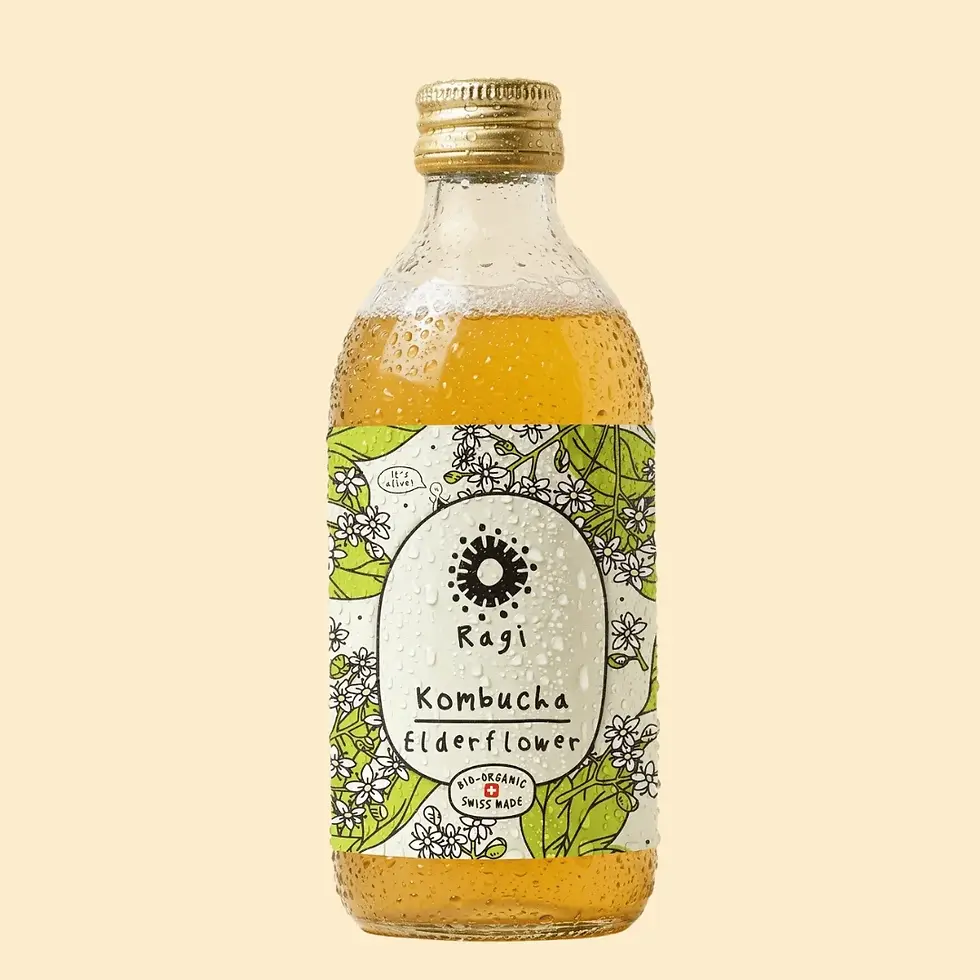
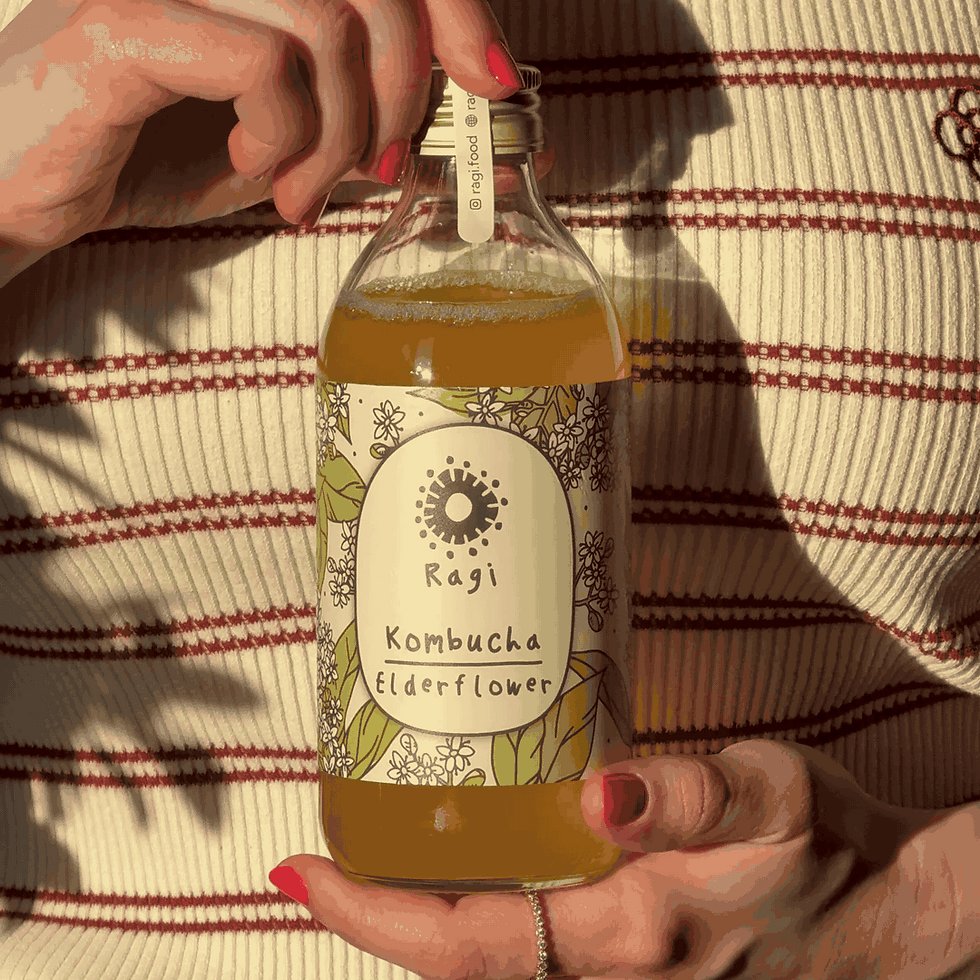


Herbst
Intensive Aromen von Oktober bis Dezember. Kürbis, Ingwer, Pflaume. Herbst in der Flasche.


Wie man es trinkt
Eiskalt, niemals heiß.
Kombucha ist ein lebendiges Getränk – er sollte niemals erhitzt werden (sonst werden die Kulturen abgetötet). So trinken wir ihn am liebsten bei Ragi.
2–4°
Eiskaltes, hohes Glas.
Nehmen Sie es aus dem Kühlschrank (2 bis 4 °C), schütteln Sie es nicht, öffnen Sie es langsam (es schäumt) und trinken Sie es kalt. Die Temperatur ist entscheidend für die Kohlensäure.
+
Aperitif oder Mahlzeit.
Brunch, Mittagessen, Abendessen – überall dort, wo man ein Glas leichten Wein trinken würde. Klassisch zu Käse, fruchtig zum Dessert.
🍸
Lebendiger Mocktail.
Kombucha auf Eis, ein paar zerdrückte frische Himbeeren und zwei angestoßene Basilikumblätter. Spritzig und duftend – in einer Minute fertig. Rezepte auf der Rezeptseite.
1 yr
Lagerung.
Ungeöffnet bis zu 1 Jahr im Kühlschrank (2–4 °C) haltbar. Nach dem Öffnen: 5 Tage, immer gekühlt aufbewahren. Der Geschmack intensiviert sich mit der Zeit – die Kulturen arbeiten sanft weiter.

Because fruit only tastes good in season — there are no strawberries in November, and apples have no flavour in July. We'd rather do less, better, and with what's ripe at the right time. That's also why some flavours go "dormant" for part of the year — we're simply waiting for the good fruit.
Between 0.5% and 1.2% vol. depending on the batch and how long it ferments — like well-risen bread, a ripe banana or a forgotten fruit juice. Officially classed as an "alcoholic drink < 1.2%" in Switzerland.
As a precaution, we advise avoiding living kombucha during pregnancy and breastfeeding (because of the unpasteurised bacteria). Ask your midwife.
Between 2.5 and 4 g per 100 ml — far less than a regular soda. Most of the starting sugar is eaten during fermentation. What's left just gives the fizz.
If you're new to it, start slow — a small glass (about 100 ml) a day for a few days, while your body gets used to the living cultures. After that, most people happily drink a bottle (33 cl) a day. Listen to your body, and drink it nice and cold.
We're not allowed to answer. Swiss law forbids makers of fermented drinks from making health claims without a validated scientific dossier (and we don't have the budget of the probiotic labs). What we CAN say, factually: it's full of living cultures, it's far less sugary than a soda, it's gluten- and lactose-free. What we'd like to say: since we started drinking it, we sleep better, we digest like champions, and we haven't caught a cold since 2020. But that's not a promise. Just an observation. ✨
"Symbiotic Culture of Bacteria and Yeast" — the gelatinous disc floating at the surface. It's the biological factory. Ours dates from 2020 and we've looked after it carefully ever since. Good to know: it's normal to find small pieces of SCOBY in the bottle — it's a sign the kombucha is alive and unpasteurised. → Read the SCOBY article

