
_edited.png)
Where it happens
The kitchen
at Lutry
Above the lake, up in the hills at the top of the steep roads of Lutry. Underground, in the old cellar, whole communities of microorganisms work away day and night, fermenting without a pause.
↑ it all comes out of here.
The Ragi story
Two pairs
of hands.
One old cellar,
fully alive

est
2020
Lutry
Founded
2020
by
Sara & David
in
Lutry, VD
How it started
London, 2020.
Two jobs lost, one tiny studio
Covid arrived in London and, within a few days, we had both lost our jobs. The city shut down completely, and we were left with six months and one very small studio.
That's where fermentation found us. David made his first kimchi. Sara started reading about the gut-brain connection, and couldn't stop. A week later David put his kimchi production on hold, because the whole studio smelled like farts. He moved on to other ferments from around the world instead. Sara, meanwhile, began thinking not only about what she liked to eat, but about what her gut microbes would like to eat too.

One thing became obvious quickly: your gut doesn't want a hero ingredient, it wants variety, and it wants it regularly. A single ferment eaten now and then does very little. Many different ferments, eaten steadily over months and years, is what actually builds a diverse microbiome. That's why we make four things instead of one, and why they change with the seasons.
Six months later we came back to Switzerland, wanting to share everything we'd picked up. Kimchi, kombucha, tempeh, water kefir: none of them were really part of everyday life here yet. So we decided to give it a go.
We rebuilt the old cellar under the house with our own hands and turned it into a proper kitchen. We got our first SCOBYs. David built a rudimentary tempeh chamber. And we started experimenting, down there in the cool and the dark.
In the early days, nobody knew what we were talking about. "Kimshii, what? Kampucha?" We got used to explaining ourselves at every market. These days it's a real pleasure to see how many people know their ferments, and want them in their week, whether for their gut or simply because they taste good.
Ragi means ferment in Indonesian. It is the name of the starting culture that turns beans into tempeh. We liked that the word refuses to sit still.
A ferment is the culture that begins the change. It is also the change itself: slow, quiet, and mostly invisible. And it is what you are left with at the end, which is never what you started with.
Nothing here is made. It is transformed.
— Sara & David


Six years, step by step
From an old cellar
to a proper lab
and we're just getting going
2020
The cellar becomes a kitchen.
We rebuild the old cellar ourselves. Finding organic, seasonal and local ingredients turns out to be the first real challenge. The first batches.
2021
The website goes live.
And the first subscribers to the Ragi Box arrive. Some of them are still with us, five years on. Can you believe it?
2022
Onto the shelves.
Shops, restaurants and cafés start stocking us. Our first markets and events.
2023
A proper lab.
The kitchen gets a professional makeover. Ragi travels beyond Romandie. And our first automatic cabbage chopper arrives.
2024
Certified organic
We earn our bio inspecta organic certification. The labelling machine also arrives, sticking labels onto every jar and bottle. Truly, a life-changing device.
2025
To Korea.
We travel to learn where kimchi comes from, and to taste it at the source.
What we believe
Six stubborn
convictions
We wrote them on the fridge door one evening. They haven't moved since. Not one of them.
01
Alive, or nothing
No pasteurisation. Ever. The cultures reach you at their liveliest. That makes everything more fragile and more expensive, and that is precisely the point.
02
Seasonal, truly
Flowers in spring, pumpkins in autumn. We ferment with whatever the season is offering, and when it's over, it's over until next year.
03
Small, on purpose
We could scale. We choose not to. Grow too fast and we'd lose our hands on every jar, and every jar is the whole point.
04
Local, first
Organic, seasonal and local wherever we can manage it. A few things, tea above all, simply don't grow here, so we look for growers we trust and we tell you where they are.
05
Reused, always
Bottles and jars are made to come back. Bring your empties to us and we'll clean them up and send them round again.
06
Diverse, by design
A diverse gut is a healthy gut. That's why we don't make one ferment but several, a variety of foods and flavours to help you diversify your microbiome in a natural, sustainable and rather enjoyable way.
Five years, counted up
The maths
of a small cellar
We are not a big company, and we like it that way. Small numbers add up, though, when you do the same thing every week for five years.
40,000
bottles of kombucha & tibicos
Filled, capped and labelled by two pairs of hands. Roughly 39,999 more than we expected to make.
100 quadrillion
bacteria & yeasts sent out
A rough count of the living cultures in those bottles. Rather more microbes than there are stars in our galaxy, give or take a few zeroes.
12,000 kg
of cabbage turned into kimchi
Chopped, salted and packed. The automatic cabbage chopper of 2023 remains the best decision we ever made.
10,000
hungry guts fed
Subscribers, shop finds, market tastings and curious first-timers. Every one a small vote for slow food.
8,000
containers reused
Rinsed, brought back, cleaned and sent out again. The closed loop actually works.
1
old cellar, now a certified lab
Still the same room under the same house above Lutry. It simply has much better equipment now.
Counted carefully, not guessed.
And already out of date, because the cultures never stop working
Organic, seasonal and as close to home as we can manage. These are the people who grow what goes into our ferments, and we're glad to have found them.

Pica & Repica
Echallens · VD
Lucas is a master of peppers. The heat in our kimchi is his.
★ peppers


Hautes Cultures
Savigny · VD
Our neighbours Aline and Romain changed careers, and now grow cabbage for us.
★ cabbage
1001 Herbes
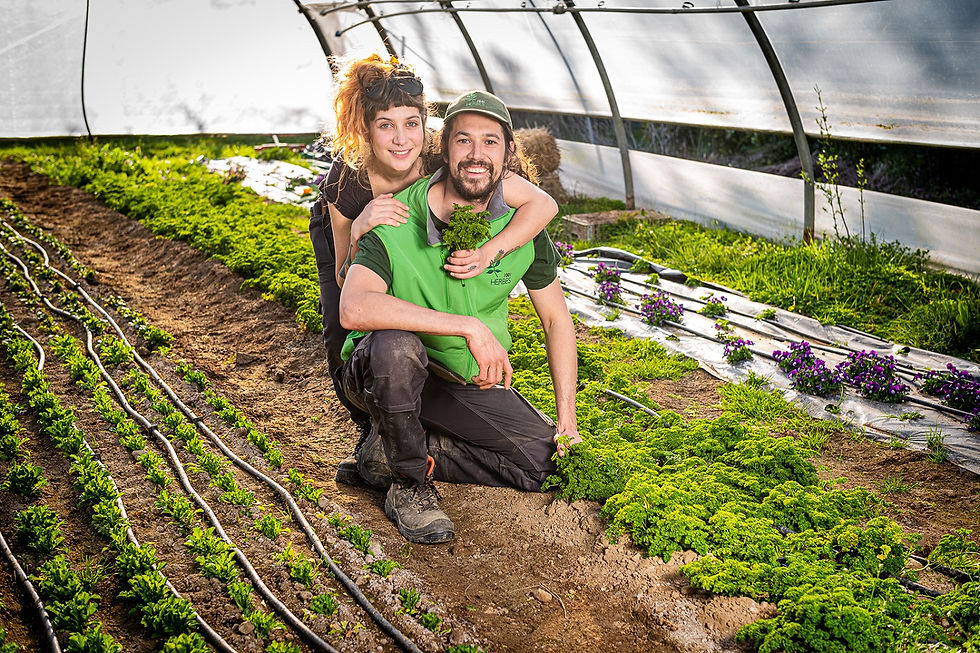
Geneva · GE
Rose, elderflower, verbena. The flowers we infuse into the drinks.
★ herbs & flowers


Domaine de la Pêcherie et la Frésaire
Aubonne · VD
Matthias walked us through the whole business of growing kiwis in Switzerland.
★ kiwis


Biofarm · Studer
St-Léonard · VS
Olivier and Audrey Studer's chickpeas, which become our tempeh.
★ chickpeas
.jpg)

Räss family
Benken · ZH
They went from potatoes to pioneering organic berries in Switzerland.
★ berries


Gorreana
Azores · Portugal
The only organic tea plantation in Europe. Our kombucha starts here.
★ tea
Come and see us
The door
is open
Everything comes out of the same cellar in Lutry. It isn't a shop, so there are no opening hours, but you're very welcome to collect your order from us. Just let us know when you'd like to come by.
Any day
Pick-up & a chat.
Order online, choose "Pick up at Ragi", and we'll email you when it's ready. Reply to arrange a time that suits you.
By arrangement
Lausanne
Pick-up at Racines.
Collect from Racines café by La Riponne, Rue Neuve 11. Tuesday to Saturday, 8am to 4pm. Stay for their food while you're there.
Second point
Soon
Fermentation workshops.
Kimchi and fermented drinks, made with your own hands. Nothing on the calendar yet, but leave your details and you'll hear first.
Coming
On request
Wholesale & restaurants.
Menus, partnerships, tastings. We look after every account ourselves, so write to us.
Wholesale
