

Our Trip to Korea to rediscover kimchi
Kimchi Day is on 22 November, and we can't think of a better moment to finally tell you about our trip to Korea. For us it's a way to say thank you to a food we love and respect so much, and that has been part of our daily life for years now.
In October last year, we went to Korea with one obsession. We wanted to eat kimchi everywhere we could and understand it better, at the source. We have been making kimchi in Lutry for a long time, so going to the place where it all comes from felt like an honour.
A whole museum just for kimchi
We started in Seoul, at Museum Kimchikan in Insadong. Yes, a museum only about kimchi. It opened in 1986 and was the first of its kind in Korea, and it's very interactive and fun.

Our favourite part was a tasting fridge. You open it and inside there are little samples of different kimchis, some with napa cabbage, some with radish, fermented for different lengths of time and with different levels of spice. We went back and forth tasting them like kids in a candy shop. It's a really fun way to understand how much kimchi changes as it ages.
We also took photos of half the walls. Here are a few facts we loved:
Koreans eat around 1.76 million tonnes of kimchi a year.
Almost every restaurant in Korea serves kimchi as a side dish (97.8%, according to the museum).
89% of Korean homes have a kimchi fridge, a separate fridge only for kimchi.
There are more than 180 recognised types of kimchi, and every family adds its own version on top.
When a neighbour brings you kimchi she has just made, you leave it out for a day or two so it starts fermenting, and only then you put it in the fridge, ideally between 0 and 5°C.
And of course we put our heads in the giant cabbage.
Kimchi follows the seasons

The part of the museum that touched us most was about the seasons. In the old Korean calendar the year was divided into 24 solar terms that told farmers when to sow and when to harvest, and kimchi followed them too.
In spring people make fresh kimchi with the first wild greens and eat it right away. Summer is for cucumber and young radish kimchi, light ones, because the heat makes everything sour very fast. In autumn you find kimchi with perilla leaves, sweet potato stems, even green persimmons. Then winter comes with kimjang, when families make huge batches of cabbage and radish kimchi together so it lasts until spring.
Reading that wall, we felt at home. It's the way we try to work too, with what each season gives us.
Baekyangsa, and the best kimchi of the trip
Then we went south to Baekyangsa, a Buddhist temple at the foot of Mount Baegam, in Naejangsan National Park. Some of you might know it from Chef's Table, because the nun Jeong Kwan cooks there, in a small hermitage next to the temple. We had to go.
In the courtyard there were dozens of dark onggi jars lined up in rows, slowly fermenting soy sauce, pastes and kimchi. We could have stayed there for hours just looking at them.
Temple food in Korea has its own rules. No meat and no fish, of course, but they also leave out five pungent plants that are everywhere in Korean cooking, like garlic and green onion. So temple kimchi is made without garlic, and without salted shrimp or fish sauce. We were really curious to see how it would taste without all that.
It was the best kimchi of our whole trip. Fresh, crunchy, with a depth we still can't explain very well.

What stayed with us even more was how they treat food. At the temple you eat in silence, you're not supposed to talk during the meal. At first it felt a bit strange, and then we realised how much more we were tasting. Every bite gets your full attention.
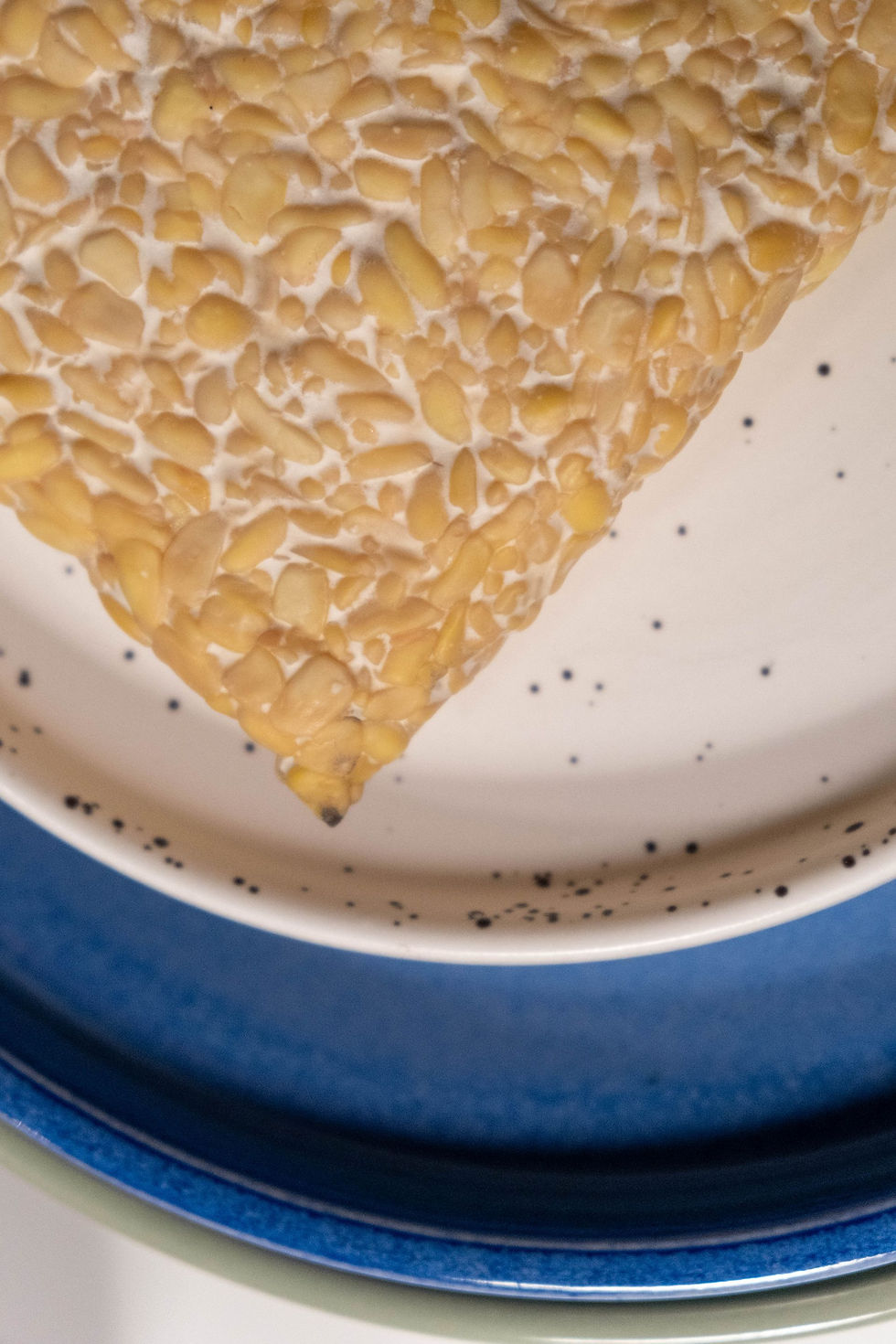
On our plates the food looked simple. Tofu with little green peppercorns on top (chopi, a Korean pepper, if we understood well), mushrooms, sprouts, black beans, wild greens and kimchi. But nothing about it is simple. Almost everything has been fermented, slowly cooked or prepared in a special way, and some of the greens are foraged in the forest around the temple. Everything is seasonal and nothing is wasted, even the stems of the vegetables go into a broth.
Sunchang and the gochugaru festival
A few days later we arrived in Sunchang, a small town famous for its gochujang, the fermented chilli paste. It was during the Sunchang Jang Festival, a festival of fermented sauces, and it was super local. As far as we could tell, we were the only tourists in town.

When we arrived we didn't really know what to do. Nobody spoke English, there was music and people everywhere, and it was a bit overwhelming. But after a little while we got used to it, and then it was just fun to watch. There was even a gochugaru making competition, and little pepper plants growing all around the town, even along the streets.

The town also has a museum about fermented sauces, and that's where we learned something that surprised us a lot. Chilli isn't Korean at all. It comes from the Americas and only arrived in Korea at the end of the 16th century, through Japan, with Portuguese traders. The first Korean text that mentions it dates from 1614.
So for centuries kimchi was made with salt and other spices, and it wasn't red. Chilli only became common in kimchi in the 19th century, and napa cabbage arrived in Korea at the end of that same century. The red cabbage kimchi everyone pictures today is less than 200 years old.
Traditional gochugaru, the Korean chilli flakes, is made from chillies dried in the sun. It gives kimchi its red colour and a fruity, slightly smoky taste, and it's not always very hot. Some are quite mild. Next to the museum there's also a fermentation research centre, and we tried to visit, but it was closed because of the festival. Next time.
The lady and her kimchi
In Sunchang we stayed in the house of a lady who didn't speak any English, and we don't speak Korean, so everything went through translation apps on our phones.
On the first evening we asked her if the big clay jars in her garden were for kimchi. She looked at us, smiled, and disappeared into the kitchen. Five minutes later she came back with a whole tasting plate of her own kimchi.
It was delicious, and the spiciest one of our trip. In Korea, families have been making their kimchi for generations, and each one has its own recipe, passed down from parents to children and shared with neighbours every autumn during kimjang. Sitting at her table, we felt like we were tasting a little piece of that history.
Kimchi at every meal, at every age
In Korea kimchi is on the table at every meal, next to the rice and all the small side dishes. Fresh kimchi is eaten as it is. When it gets more sour, it goes with noodles or soup. And very sour kimchi is never thrown away, it becomes kimchi jjigae (a stew), fried rice or crispy pancakes. We knew all this in theory, but seeing it at every single table made it real. Old kimchi isn't a problem there, it's a treasure.
If you go to Korea and you're vegan like us, here are some dishes where you can enjoy kimchi.
Bibimbap, a bowl of rice topped with lots of seasoned vegetables and chilli paste. Ask for it without egg or meat.
Kimbap, big rolls of rice and vegetables wrapped in seaweed, a bit like a big sushi. Vegetable kimbap is easy to find.
Kimchi jeon, crispy kimchi pancakes, perfect with very sour kimchi.
Kimchi bokkeumbap, kimchi fried rice.
Temple food restaurants, where everything is plant-based, kimchi included.
Good to know, a lot of kimchi in Korea is made with fish sauce or salted shrimp, so if you're vegan it's worth asking, or looking for temple kimchi.
Happy Kimchi Day
Korea reminded us that kimchi is much more than a side dish. Neighbours give it to each other, every family has its own, and a lady who couldn't understand a word we said shared hers with us like it was the most natural thing in the world.
So on 22 November we'll be thinking of her, and of that temple kitchen in the mountains. If you'd like to celebrate with us, our seasonal kimchis are in the shop. And if you're just discovering kimchi, our guide What Is Kimchi? is a good place to start.
With love,
Sara & David


Comments